
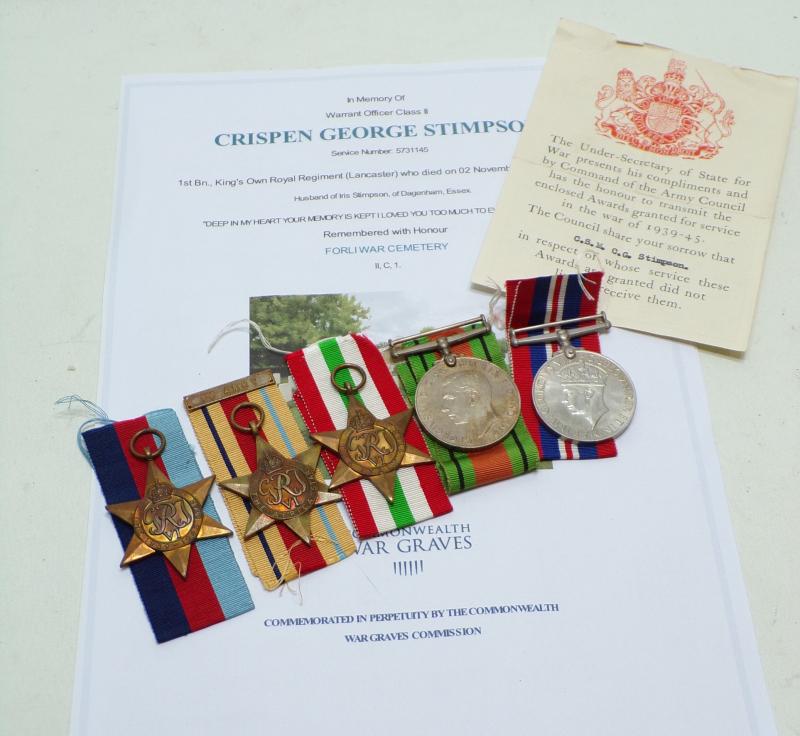
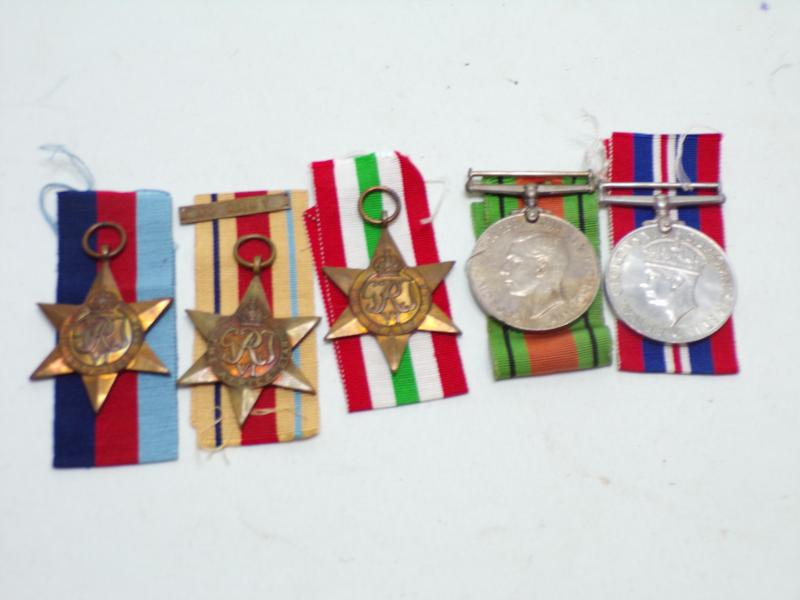
WW2 Medal Group to Stimpson KORR KIA Italy 1944.
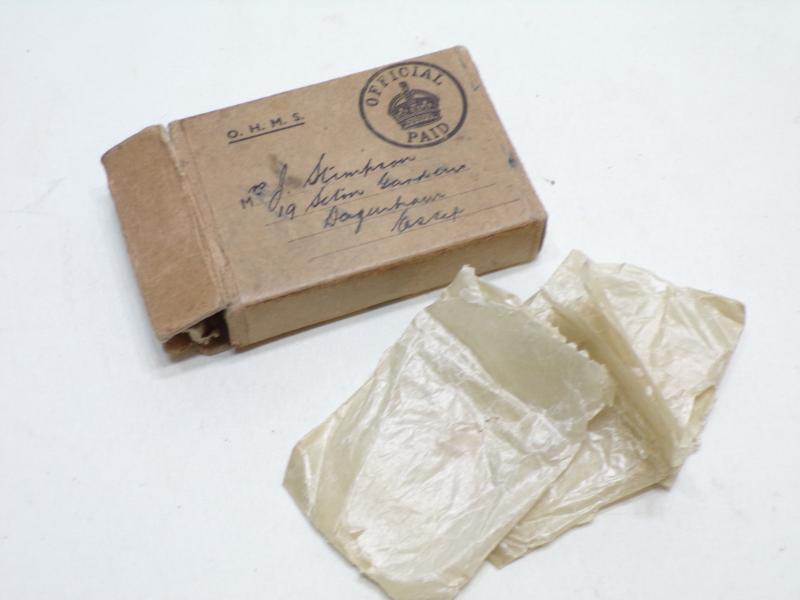
A WW2 medal group comprising of the 1939/45 star, Africa star, Italy star, Defence and 1939/45 war medal in named box of issue and condolence medal issue slip relating to 5731145 Warrant officer II Crispen George Stimpson of the 1st battalion Kings Own Royal Regiment (Lancaster).
Crispen Stimpson was born in London on 13th October 1917. He was already serving in the KORR when war broke out. The 1st Battalion moved from Madras to Karachi, then in India, and began duties associated with coastal defence and internal security. There were also intensive periods of training in readiness for future action.
Following a pro-German coup in Baghdad, Iraq, under Raschid Ali, the 1st King's Own flew in stages from India along the Gulf to Shaibah in Iraq. With the RAF base at Habbaniya under threat the battalion arrived 23rd April 1941. A month later Iraqi forces surround the RAF station at Habbaniya. 1st King's Own and the RAF combine forces had no heavy weapons and most of the equipment was old and not up to the Iraqi enemy. The two First World War artillery pieces, located outside Air Force House, were brought back into use and the 1st King's Own encountered Iraqi forces on 6th May. After several days of battle the Iraq forces were held back and the battalion were moved on to Bagdad, coming in to contact with the enemy at Fallujah. The battalion face stiff resistance at Fallujah but defeated the Iraqi forces. A couple of days later the threat from Baghdad was over and Raschid Ali fled the region, Iraq remained pro-British and an important air transit route and source of oil remained in Allied hands. They stayed in Iraq until 28th may 1942, when the 1st battalion was moved to Egypt. They are put immediately into action, the 1st Battalion moved to a plateau overlooking Sollum Bay near the Libyan Egyptian Border, known as the 'Sollum Box'. The 1st King's Own took up a defensive position but with the ever-increasing German threat, the battalion began to fall back along the Mediterranean coast to Mersa Matruh, the airfield at Fuka and to the railway station at El Alamein. It was here that the battalion re-organised, established its losses - many men were killed, wounded or had been taken prisoner. Major Walton reformed the battalion on the 1st of July and the line held. From the harsh fighting at El Alamein the battalion was sent to Cyprus on garrison duty in August 1942, part of the 10th Indian Division.
The battalion left Port Said on the morning of 17th August 1942. The convoy consisted of three destroyers, one armed merchant ship and HM Troopship Princess Marguerite containing divisional headquarters, 1st King's Own and about 500 Indian troops. At 3.10pm on the same day Princess Marguerite was torpedoed by an enemy submarine; one of the oil tanks exploded and caught fire in a few seconds and the ship rapidly started to sink. Five minutes after she was hit the order was given to abandon ship, but owing to the flaming decks it was only possible to lower five life boats. The destroyer HMS Hero was detailed to pick up survivors. By 3.30pm most of the troops were in the water swimming towards Hero. Ten minutes later Princess Marguerite gently rolled over and sank. The loss of life amounted to sixty, King's Own casualties being one officer and 23 other ranks. The submarine was never seen - although a search continued until midday on the 18th. Hero deposited her unexpected passengers once more on the quays at Port Said, Stimpson had survived. The 1st Battalion eventually reach Cyprus on 27th August 1941 and moved into barracks at Dhekelia. There now followed the amalgamation of three depleted units - 1st King's Own, 1st Duke of Cornwall's Light Infantry and 1st South Wales Borderers joined together. They took the title of the senior unit The King's Own.
In November 1943 they were transferred to the island of Leros, situated between Greece and Turkey. On 12th November the King's Own and three other battalions on the island of Leros were subjected to German airborne and sea landings. This was the last major German parachute attack of the war. The British soldiers were in a desperate situation. There was no hope of air support to protect them and after four days of fierce fighting the island surrendered. The 1st Battalion was virtually wiped out. Only about 58 men of the King's Own managed to escape from the island to Palestine. Many were taken prisoner and an unknown number were left dead and wounded. But Stimpson was lucky and managed to escape.
The handful of survivors of Leros had made their way back to Palestine and joined with the 8th Battalion King's Own who had moved there from Malta, via Egypt. It was decided to merge the 1st Battalion with the 8th - and reform a new 1st Battalion. This took place on 30th January 1944. The new battalion remained part of the 25th Infantry Brigade of the 10th Indian Division.
The Battalion moved to Italy in late spring 1944 and advanced with the 25th Indian Brigade to the east of the River Tiber. As they approached the market town of Umbertide resistance stiffened but the battalion continued to have success in a number of minor operations. The Germans made a stand at Montone, a hill top village to the east of Umbertide and the 1st King’s Own were involved in this action. After a successful approach to the village, and bitter house to house fighting, the town was successfully taken with 20 Germans killed and a further 85 taken prisoner. Battalion casualties were 5 killed and 23 wounded. 'Montone' was awarded as a unique battle honour, and the Commanding Officer, Lt Col Richard Anderson was awarded the Distinguished Service Order for his leadership.
The push northwards continued, as did German resistance, and on 13th July the battalion launched it's first night attack to open the road to Citta di Castello which was occupied on the 22nd. The battalion was almost always on the move, following the fighting withdrawal of the German army, but rest came on 12th September when they were withdrawn from the front line. On 3rd October the Battalion was transferred to the Adriatic sector where it joined the 8th Army. The advance was at times slow and difficult over the next month, fighting through northern Italy to breach the formidable Gothic Line and push into the Po Valley. In the northern Appenine mountains the Gothic Line, was breached by the Allies during the Autumn campaign and the front inched forward as far as Ravenna in the Adratic sector. It was in this region that WOII Stimpson was killed on the 2nd November 1944.
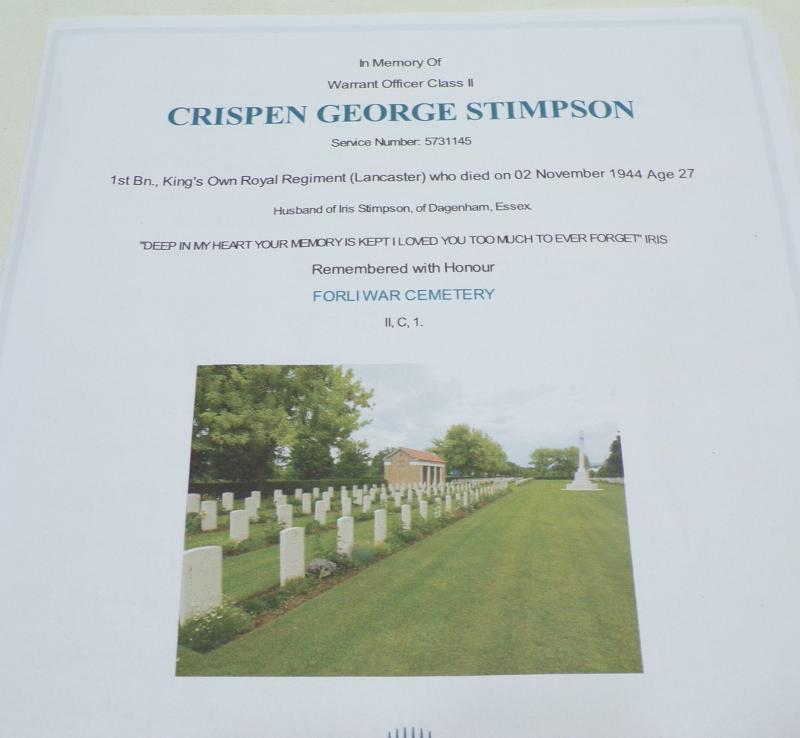
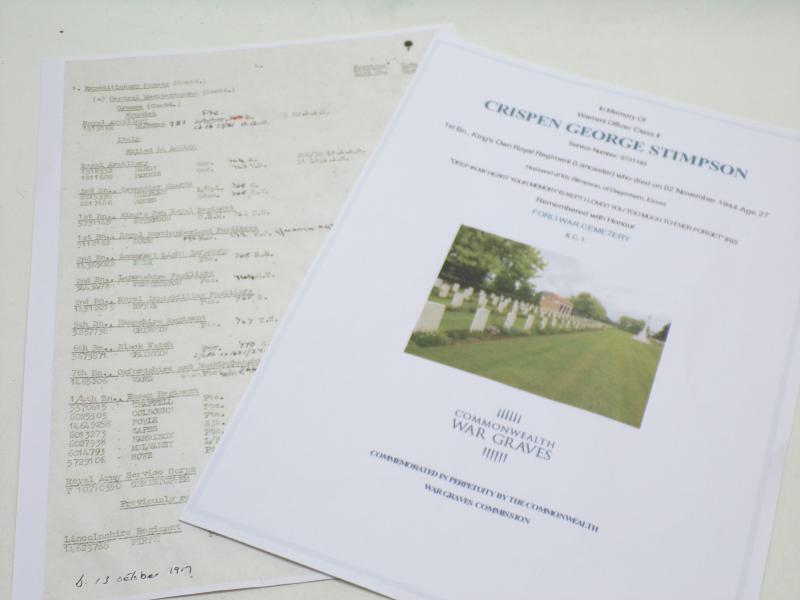
He is now remembered with honour at the Forli War Cemetery, Italy. He left behind his wife Iris who resided in Dagenham, Essex.
Forli War Cemetery site was selected soon after the Eighth Army took Forli in November 1944 and graves were brought into it from the surrounding battlefields. Many of those buried there lost their lives in the heavy fighting between Rimini and Ravenna which took place in appalling weather in October-December 1944.
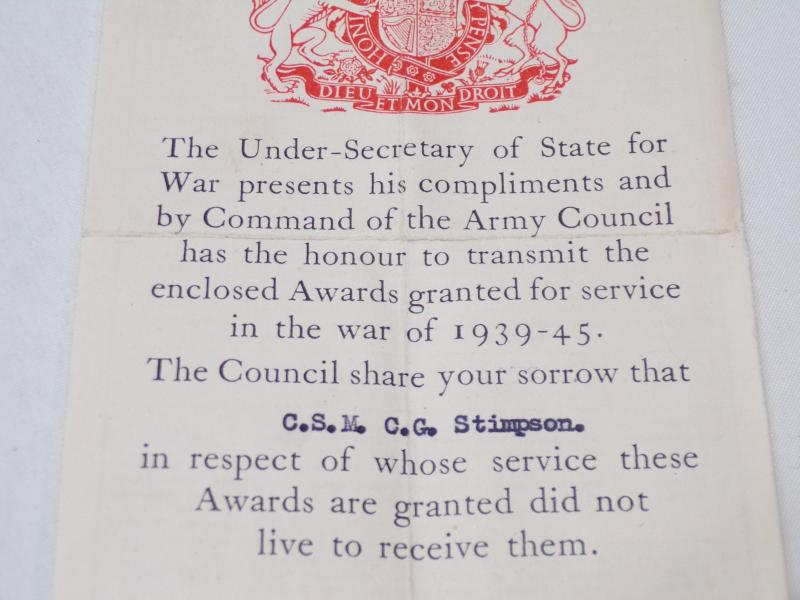
Crispen Stimpon’s medal are in their box of issue addressed to Mrs I Stimpson. The come in mint condition and in their original wax packets with ribbons. the box also contains the original medal / condolence slip, stating his award of five medals. He holds the rank of Company Sergeant Major on the slip.
Comes with commonwealth war graves certificate and part casualty roll Central Mediterranean November 1944.
Code: 31702
180.00 GBP