
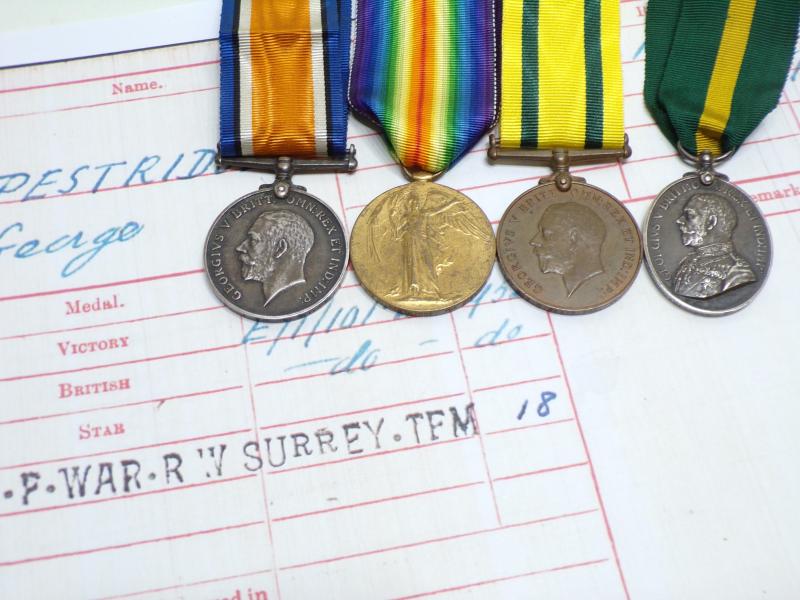
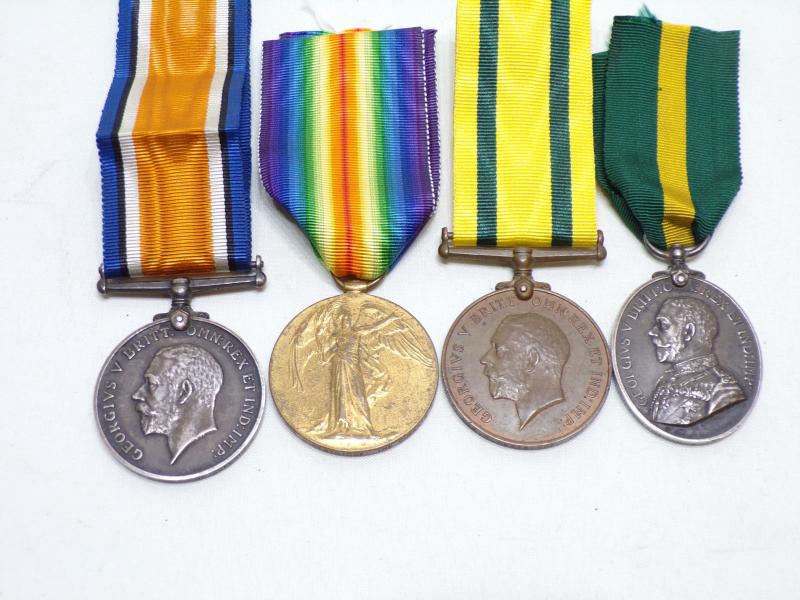
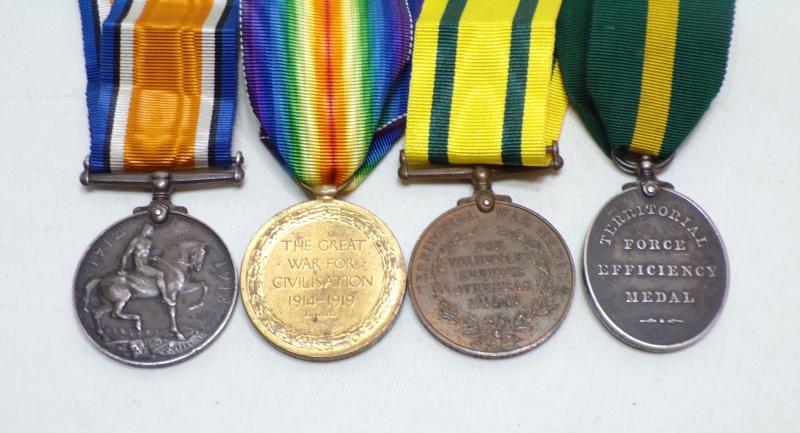
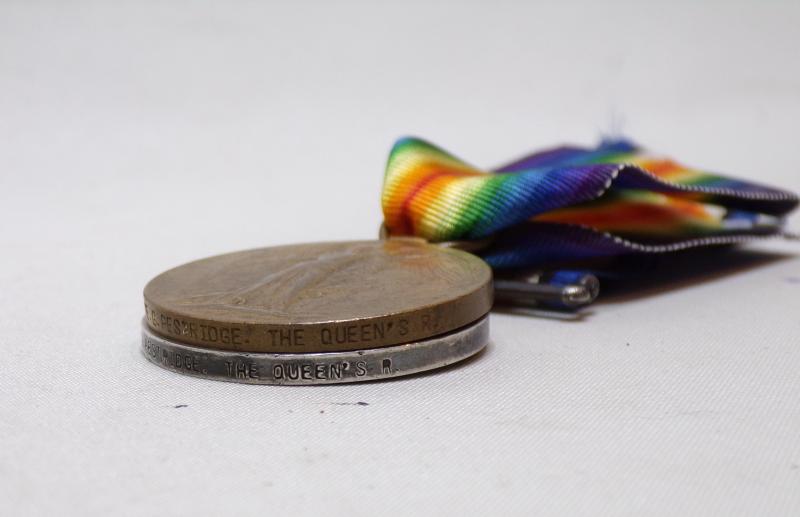
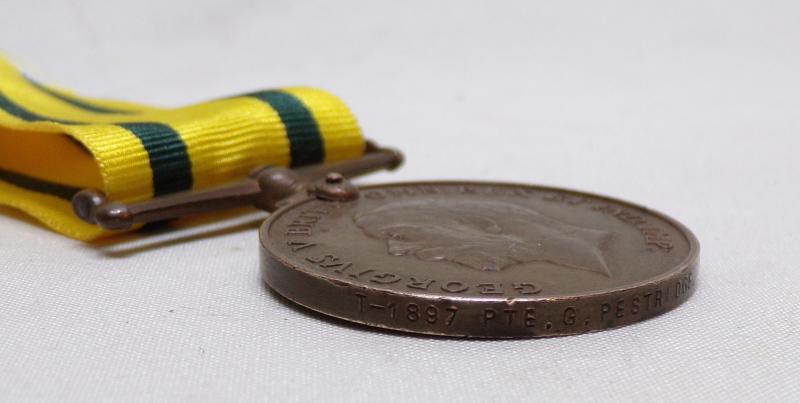
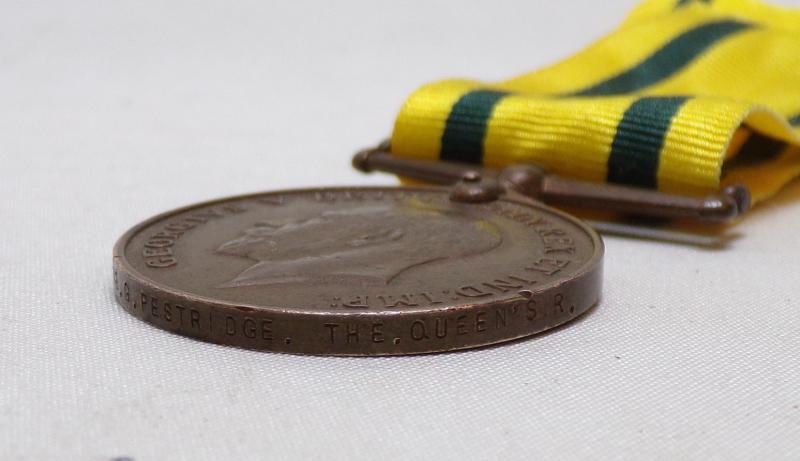
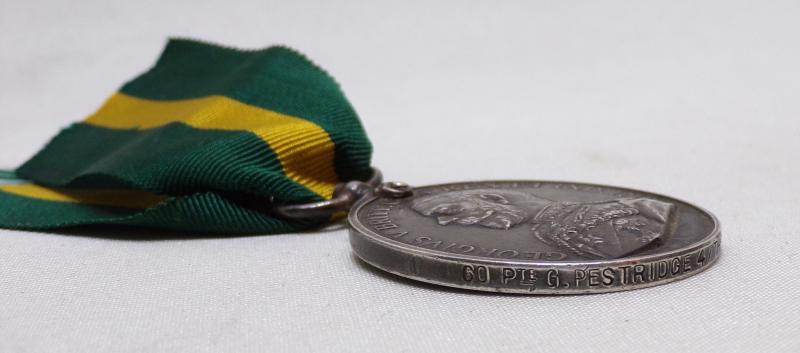
WW1 Territorial Group to Pestridge Queens West Surrey Regiment.
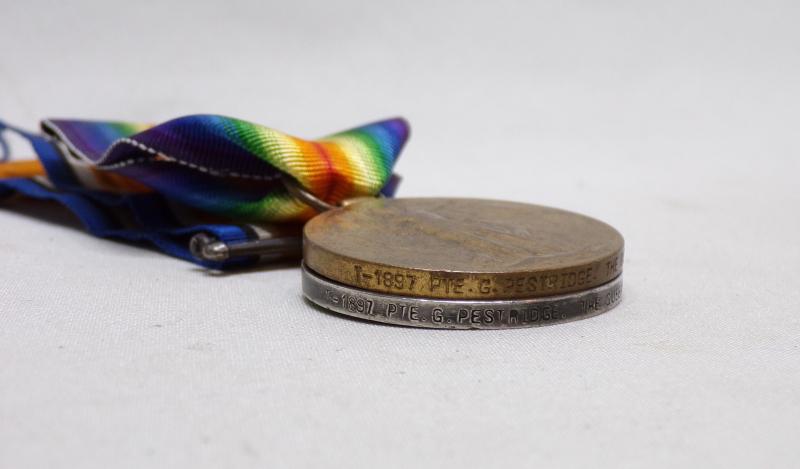
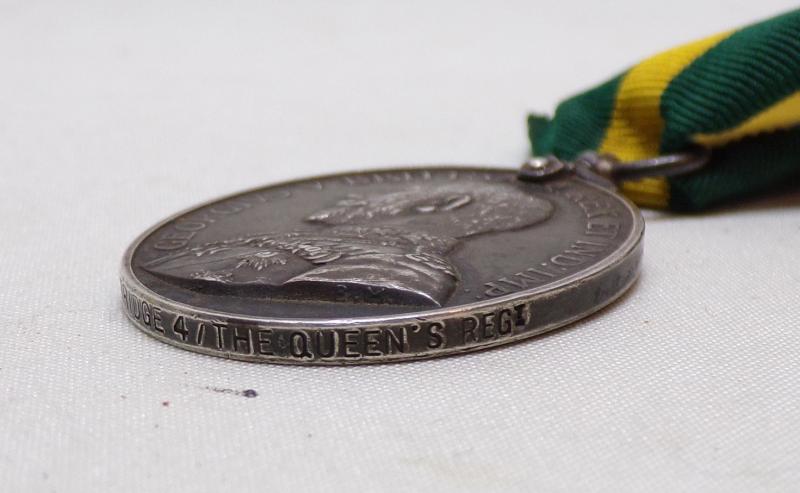
A superb and scarce WW1 Group comprising of the WW1 British war and Victory medal correctly named to T-1897. Pte. G. Pestridge. The Queen’s R. Territorial Force War Medal Correctly named to T-1897. G. Pestridge. The Queen’s R. and the Territorial Force Efficiency medal correctly named to 60. Pte G Pestridge. 4/ the Queens Regiment.
Note. His TFWM is just one of only 435 awarded to OR’s of all the territorial battalions of the Queens regiment.
George Pestridge was born on 29th June 1880 in Balham. Now southwest London. When George was born, Balham was still in the heart of the countryside of Surrey. His father was a gardener and nurseryman and when George started work he became a nurseryman’s assistant. He must have joined the 4th Queens regiment before Haldane Reforms of 1908, when it was a Surrey Volunteer battalion as his TFEM was awarded in 1915, awarded for twelve years’ service, but after 1908 previous service in the Volunteer Force counted.
The 4th Battalion, Queen's Royal Regiment (West Surrey) was Mobilised on the 15th August 1914 and those like George that volunteered for overseas service were sent to India to relieve the regular army serving there.
They disembarked at Bombay 1st to 3rd December 1914. It was then split up and the battalions were distributed to stations all over India. The 1/4th Queen's served briefly in 9th (Secunderabad) Division serving on internal security duties, then in January 1915 transferred to the 8th (Lucknow) Division, moving to Allahabad under that division in April. In January 1916 it transferred again to Nowshera, Srinagar, in the 1st (Peshawar) Division on the North West Frontier,. The division was frequently mobilised for active service, which gained the battalion the battle honour North West Frontier 1916–1917. In March 1917 it moved to 3rd (Lahore) Divisional Area, which became 16th Indian Division in May that year. The battalion remained with that formation until the end of the war, but like all the Home Counties Division units it sent drafts of officers and men to reinforce other fronts, and men from 1/4th Bn saw action in Mesopotamia. The 1st/4th were part of the Tigris Corps formed in 1916 to attempt to relieve 6th (Poona) Division at the besieged Kut-al-Amara.
The Tigris Corps set out to rescue 13,000 British and Indian troops trapped at Kut-al-Amara under the command of Major-General Charles Townshend. Through arrogance and miscalculation, the Poona division found themselves on an 87 mile along the River Tigris to Amara, capturing it on 4 June 1915.
From Amara, Townshend was ordered to push on, first to Kut, and then to Baghdad, another 250 miles away. His division entered Kut on 28th September 1915, having inflicted heavy losses on the Turks and by mid-November the division was only 25 miles from Baghdad. But a single division was not strong enough for such an operation. Sickness and a lack of artillery, ammunition and supplies had seriously weakened Townshend's force. Even if he had been able to capture Baghdad, he did not have the necessary reserves or logistical support to retain it. Nevertheless, Townshend pushed on against the recommendations of his subordinate officers. On 21st-23rd of November 1915, Townshend was blocked by the Turks at the battle of Ctesiphon. Suffering heavy losses, he decided to retreat back to Kut.
On the 7th December 1915, the Turks surrounded Townshend’s 10,000 troops and 3,500 camp followers in the walled city. For the next few weeks, they launched attacks against the Kut defences. Along with the regular shelling, this took a steady toll on the garrison, which only had food and supplies to last two and a half months. The defenders were slowly starving. The OR’s put on vastly reduced rations, the officers, not so much.
In early January, two Indian divisions, known as the Tigris Corps, were despatched under the command of Lieutenant-General Sir Fenton Aylmer to relieve Townshend’s beleaguered forces. The Queens forming part of the 3rd (Lahore) Division. The Corps attacked Ottoman lines along the Tigris River in January 1916. They fought bloody battles in harsh desert mud at Shaikh Sa'ad, Wadi, and the Hanna Defile. The whole desperate operation failed and Kut-al-Amara surrendered to the Turks on the 29th April, and 13,000 men marched into an horrific captivity. Many officers elected to stay with their men, those who didn’t such as Townsend himself were given almost luxury quarters in hotels. The episode was one of the British Empire’s worst defeats of the war.
The Tigris Corps had suffered heavily in their efforts suffering around 23,000 casualties.
The British Government then took over control of the campaign from the Indian General Staff. In July 1916, it placed Lieutenant General Sir Frederick Maude in charge. After slow progress, unlike his predecessors, Maude was a methodical leader whose force was boosted by increased artillery and improved logistical, medical and transport support. It is difficult to find out where the 1st/4th battalion the Queens when next, now only a small contingent of the Corps they have no war diary for this part of the war. In the many accounts and despatched of the Mesopotamian campaign I have read, the Queens do get mentioned right the way through to Maude’s Victory and some were with the corps at the end, 14th November 1918. The battalion was Disbanded on 20th December 1919. However, George was transferred to the S E Reg on the 1st of October 1919. This is the South Eastern Regiment. So, at this point he was probably back home. The S E Regiment was made up of bits and pieces of all the regiments from home counties, battalions that were too small to make up their old battalion. From here he was discharged. A lot more research is needed on this man but as far as I can gather the above is correct.
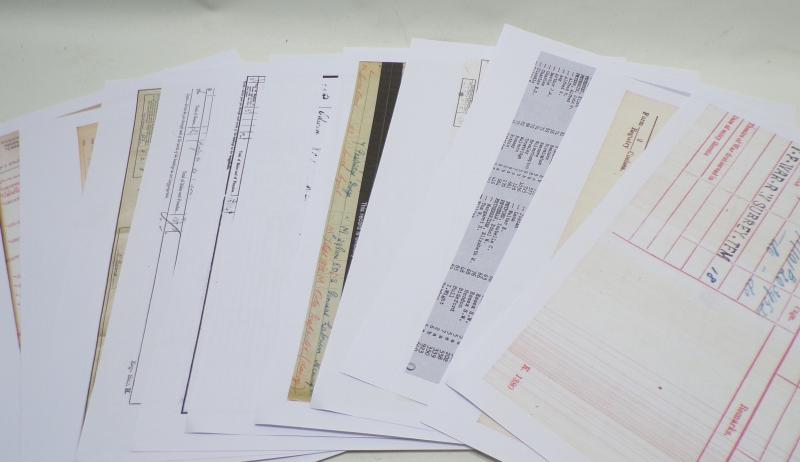
His medals are in very good condition and come mounted on Original and replacement ribbon on the TFWM. A rare grouping only a small number to this regiment. The are accompanied by various pages of research confirming most of the above.
Code: 31703
470.00 GBP